No Win, No Fee
Las Vegas Truck Blind Spot Accident Lawyer
If you or a loved one has been in a truck blind spot accident in Las Vegas or Clark County‚ you may be facing extreme injuries and expenses in medical care․ 18-wheeler accidents (big rigs‚ semi-trucks‚ tractor-trailer accidents) can have devastating effects on victims and their families․ Blind spots on trucks can create risks for drivers and passengers․
If you need a las vegas truck blind spot accident lawyer‚ the team at Winder Law Firm is ready to help․

No Upfront Legal Fees
Free, Confidential Case Review

Local Insight
Replies Within 1 Business Day


National Top 100 Black Lawyers

American Association for Justice

Nevada Justice Association

Understanding Truck Blind Spot Accidents in Las Vegas
Truck blind spot crashes are among the deadliest types of collisions on Las Vegas roads. Here is what causes them and why they can be so dangerous.
What Is a Truck Blind Spot (“No Zone”)?
Blind spots are areas around a truck that the driver cannot see in the mirrors. The FMCSA calls these areas “No Zones.” They are far larger than those on a regular car because a semi can stretch 70 to 80 feet long.
A semi-truck blind spot accident can happen because an entire car can vanish inside one of these zones. Even so, truck drivers have a legal duty to check mirrors before changing lanes or turning, as required by 49 CFR § 393.80.
Where Are a Semi-Truck’s Blind Spots Located?
The FMCSA’s No Zone infographic shows four blind spots on every large truck:
- Front: About 20 feet ahead of the cab, hidden by the high hood.
- Rear: About 30 feet behind the trailer, with zero rearview mirror visibility.
- Left side: Roughly one lane wide, from the cab door back to mid-trailer.
- Right side: About two full lanes wide along the entire truck. This is the largest and most deadly zone.
Why Blind Spot Accidents Are So Dangerous
A loaded semi can weigh up to 80,000 pounds, 20 times a typical car. The FMCSA notes that a truck at highway speed needs up to 600 feet to stop, which is 40% farther than a car.
In Las Vegas, many of these crashes happen on I-15, I-515, and US-95 at high speeds. A big rig blind spot accident at freeway speed can cause pile-ups, underride crashes, and life-altering injuries.
Common Types of Accidents Caused by Truck Blind Spots
There are many known types of blind spot crashes․ The most common in Las Vegas are listed below․
Sideswipe and Lane-Change Collisions
If a truck is next to a vehicle in its blind spot‚ the truck may move the other vehicle out of its lane or cause spin-outs or multi-lane crashes․ IIHS estimated technology to reduce blind spots could prevent nearly 39000 of 97000 annual lane change crashes with trucks․
Rear-End and Underride Accidents
The rear blind spot extends 30 feet behind the trailer‚ and a truck may back up or stop without knowing that there is a car behind it․
Underride crashes involve a car sliding underneath the trailer of a tractor-trailer‚ shearing off the roof of the car․ Underride is a feature of a large share of fatal truck crashes, according to the IIHS.
No-Contact and Run-Off-Road Crashes
For example, a truck may pull out into traffic without checking blind spots‚ forcing another vehicle off the road or into a crash barrier without being hit‚ would be a valid claim if the truck caused it․
If you were forced off the road by a truck, a las vegas truck blind spot accident lawyer can help prove what happened.
Pedestrian and Bicycle Accidents
Large blind spots in Las Vegas prevent truck drivers from seeing people walking or biking in crosswalks or in parking lots and delivery zones․ A person in a crosswalk can be in the truck’s large front blind spot of 20 feet (6․1 m) and a person biking right of a truck making a right turn can be pinned against the curb․


Table of Content

- Understanding Truck Blind Spot Accidents in Las Vegas
- Common Types of Accidents Caused by Truck Blind Spots
- What We’ll Do For You
- Who Can Be Sued in a Truck Blind Spot Accident Lawsuit?
- What Financial Compensation May Be Available After a Truck Blind Spot Accident?
- Steps to Take If You Are in a Truck Blind Spot Accident in Las Vegas
- Common Injuries from Truck Blind Spot Accidents
- What Drivers Need to Know for Driving Around Big Rigs
- Common Causes of Truck Blind Spot Accidents
- Nevada Laws Related To Truck Blind Spot Accidents
- Nevada Truck Accident Stats
- Nevada Truck Blind Spot Accident Resources
- Get a Free Consultation for a Truck Blind Spot Accident Lawsuit
- Where is Winder Law Firm’s Office?

Were you injured in a Truck Blind Spot Accident in Nevada?
TESTIMONIALS
Clients Have
Confidence In Us
← Swipe to view stories →
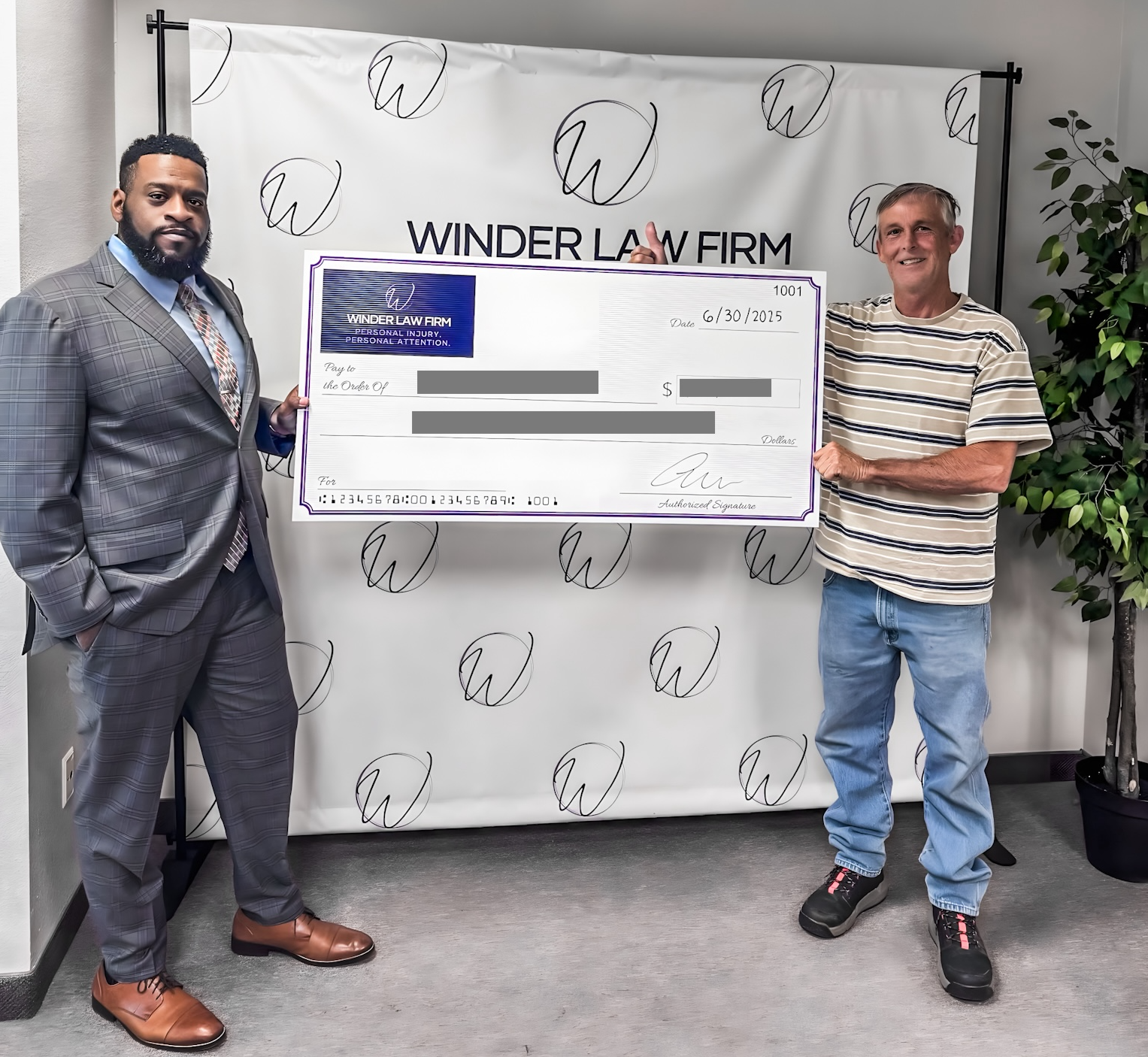
Aaron was awesome!! Met me on Saturday morning the day after an accident to get things rolling. He said we had a case, just need to be patience and things will work out. After countless PT trips, surgery, and mri's my body is back to where it was...I am not the most patience person, so I appreciate Aaron and his colleagues dealing with me and getting the maximum that was available..Local people who care about locals!!!!! I HIGHLY recommend Winder law firm.
Joe Lewis
Las Vegas, NV

My experience with the Winder Law Firm was excellent. He truly cared for my well being and was present every step of the way, until my case was resolved. I highly recommend Aaron and his team.
Sandra Deleon
Las Vegas, NV
Disclaimer: Legal outcomes vary. Past results do not guarantee future outcomes.
What We’ll Do For You
Truck accident claims are different from other car accident cases․ The Winder Law Firm takes care of your case while you focus on recovery․
Investigating the Truck Accident and Preserving Evidence
Black box data on a truck’s ECM can be over-written within 30 days; ELD records are saved for six months․ Dashcam footage is typically erased within days․
We issue preservation letters‚ obtain police crash reports‚ witness statements and photographs of the accident scene‚ and driver logbooks and maintenance records․
Handling Insurance Companies and Trucking Corporations
Trucking companies have large insurance limits and teams of attorneys․ We handle the discussions with your insurance company‚ pushing back against low settlement offers and handling communication to protect your case․
Local Experience in Clark County Courts
Truck accident cases in this region are filed in the Eighth Judicial District Court in Clark County․ Having knowledge of local judges and courts can impact your case strategy․
Meet Aaron A. Winder
Aaron A. Winder is a fourth-generation Las Vegas native who founded the Winder Law Firm in 2024. He earned his J.D. from Gonzaga University School of Law and his B.A. from UC Santa Barbara.
Aaron oversees every case personally. He and his father, Dan M. Winder (Of Counsel), are reported to be the first African-American father-son duo admitted to the Nevada State Bar. Learn more on the attorney profile page.
Who Can Be Sued in a Truck Blind Spot Accident Lawsuit?
Truck accidents often involve more than one party being at fault․ A las vegas truck blind spot accident attorney will search for all possible avenues of liability to strengthen your case․
Possible At-Fault Parties
Liability would depend on who was negligent or violated safety statutes․ In many collisions that involve blind spots‚ more than one party may be liable․
Truck Driver Negligence (Failure to Check Blind Spots, Unsafe Driving)
Common types of negligence include improper lane changes‚ failure to use turn signals‚ distracted driving‚ drowsy driving‚ and speeding․ Professional truck drivers have a duty to check blind spots․
Trucking Company Liability (Training, Policies, Pressure, Violations)
Under Nevada’s respondeat superior doctrine, a trucking company may be held liable for its driver’s negligence. Claims can also arise from poor training, negligent hiring, pressure to meet unrealistic schedules, and failure to follow federal safety rules.
Third Parties (Maintenance, Manufacturers, Cargo Loaders, Other Drivers)
Other parties that may share liability include:
- Maintenance providers who failed to fix mirrors or safety equipment
- Manufacturers of defective truck parts
- Cargo loaders whose improper loading affected visibility or handling
- Other drivers whose actions played a role in the crash
What Financial Compensation May Be Available After a Truck Blind Spot Accident?
If you were injured‚ you may be eligible to pursue compensation․ In most personal injury cases‚ Nevada does not cap compensatory damages․
Economic damages include past and future medical costs‚ lost income‚ lost earning capacity‚ property damage‚ and the cost of future long-term care․
Non-economic damages include pain‚ suffering‚ emotional anguish‚ loss of enjoyment of life and loss of consortium with your family․ If you need to pursue non-economic damages and you want the Winder Law Firm to review your case for free‚ contact our Las Vegas truck blind spot accident lawyers․
Steps to Take If You Are in a Truck Blind Spot Accident in Las Vegas
Taking the right steps early can protect both your health and your legal rights.
- Get to safety and move away from danger if you can.
- Check for injuries and call 911. Some injuries take hours or days to show up.
- Get medical care right away. A same-day medical record can serve as strong evidence.
- File a police report and ask for a copy.
Gather and protect evidence:
- Take photos of vehicles, road conditions, and your injuries.
- Exchange information with the truck driver but do not admit fault.
Take legal action:
- Notify your insurance company.
- Talk to a lawyer promptly. Nevada has a two-year statute of limitations for injury claims (NRS 11.190).
Common Injuries from Truck Blind Spot Accidents
The extreme weight gap between a truck and a car means injuries can be severe:
- Traumatic brain injuries (TBI): From concussions to severe brain damage, with symptoms that may take days to appear.
- Spinal cord injuries and paralysis: Can cause paraplegia or quadriplegia, with lifetime care costs which can be significant.
- Broken bones and internal injuries: Fractures often need surgery, and internal bleeding can be hidden and deadly.
Many victims face long-term rehab, permanent disability, and chronic pain. Las Vegas truck blind spot accident attorneys at the Winder Law Firm understand the full cost of these injuries and work to account for that in your claim.
What Drivers Need to Know for Driving Around Big Rigs
Truck drivers must check for blind spots, and knowing where these No Zones are can help you stay safer on the road․
Visual Guide to Truck Blind Spots (Front, Rear, Left, Right)
The front blind spot extends approximately 20 feet in front of the cab‚ while the rear blind spot is 30 feet․
On the left side‚ the zone represents a full lane near the cab‚ while the zone on the right represents two full lanes the length of the truck․
Note: A diagram showing these zones can be added to the final published page.
Safe Driving Tips Around Semi-Trucks
Never linger in trucks’ blind spots․ Always pass trucks on their left sides‚ where the blind spot is smaller․ Keep a safe distance‚ as always remember: “If you can’t see the truck driver in their mirror‚ they can’t see you․”
When You May Be Partially at Fault for Staying in a Blind Spot
Nevada follows a modified comparative fault rule under NRS 41.141. Your compensation may be reduced by your share of the fault, but you can still recover as long as your fault stays below 51%.
Common Causes of Truck Blind Spot Accidents
Here are some data based causes of truck blind spot accidents.
Lack of Visibility to Driver
Large trucks have wide blind spots. These are areas where people and cars can disappear from view. A European study found this was a major cause of crashes at intersections. In cases with pedestrians or cyclists, the blind spot was identified as a main factor in nearly half of the events studied.
Failure to Check Blind Spot Mirrors
Checking mirrors is a basic step, but it does not always happen. A 2022 study found drivers often skip looking at blind-spot mirrors before they move. That small gap in attention may contribute to a crash.
Right-Turn Collisions at Intersections
Right turns are a known risk. A 2021 test-track study showed that crashes often happen when a truck turns right while a cyclist or pedestrian moves next to it. The person is in a place the driver may not see.
Improper Use or Interpretation of Mirrors
In its 1995 review, NHTSA found that mirror-related mistakes are not about whether something is seen, but whether it is understood. Drivers may see a vehicle but not process it correctly.
Nevada Laws Related To Truck Blind Spot Accidents
If you’re considering filing a lawsuit after a truck blind spot accident in Nevada, it’s helpful to understand the laws that may apply. Below are some of the most important ones.
Disclaimer: These law summaries are not exhaustive and are provided for general understanding only. They reflect Nevada law at the time of writing and may be subject to updates or change. For legal advice or a full interpretation, consult an attorney. Always check with an attorney or the Nevada Legislature for the most current information.
NRS 41.141 – Allows an injured person to recover damages as long as they are not more at fault than the other parties, with compensation reduced based on their share of fault.
NRS 11.190 – Sets a two-year deadline to file a personal injury or wrongful death lawsuit in Nevada.
NRS 41.085 – Allows family members and representatives to bring a wrongful death claim when someone is killed due to another person’s wrongful act or negligence.
NRS 484E.010 – Requires drivers involved in an accident causing injury or death to immediately stop at or near the scene.
NRS 484E.030 – Requires drivers in injury accidents to provide identifying information and give reasonable aid to injured persons.
NRS 484E.070 – Requires drivers to file a crash report with the Nevada Department of Motor Vehicles within 10 days if the accident involves injury, death, or significant property damage.
NRS 484B.627 – Requires drivers not to impede traffic by driving too slowly and prohibits stopping in a way that blocks normal traffic flow unless necessary for safety.
NRS 484B.653 – Requires drivers to only turn or change lanes when it can be done safely and to properly signal before doing so.
NRS 484B.600 – Prohibits driving at speeds that are unsafe for conditions or that endanger people or property, even if within posted limits.
NRS 484B.253 – Requires drivers turning left to yield to oncoming traffic that poses an immediate hazard.
Nevada Truck Accident Stats
Here are some Nevada truck accident stats from 2020 NHTSA public data:
- Looking at the numbers from 2020, large trucks played a role in a portion of Nevada’s fatal crashes. There were 32 large trucks involved in those incidents, making up 7.1% of all vehicles in fatal crashes.
- Large-truck crashes in Nevada led to 38 deaths in 2020.
Nevada Truck Blind Spot Accident Resources
Here are some resources that someone affected by a truck blind spot accident might find helpful.
Nevada Injury Resources
Nevada Department of Transportation (NDOT)
NDOT oversees the state’s highways and roads and provides traffic data, construction updates, and planning details that may relate to crash conditions.
Nevada Office of Traffic Safety (Zero Fatalities Nevada)
This program offers crash statistics, safety education, and public efforts aimed at reducing serious injuries and deaths on Nevada roads.
Nevada Department of Public Safety (DPS)
DPS, which includes Nevada Highway Patrol, provides information on crash reporting, traffic laws, and public safety services after accidents.
Nevada Legal Aid Center of Southern Nevada
This nonprofit group provides free or low-cost legal services for residents dealing with civil matters, including injury-related issues.
Clark County Courts
Provides tools for case search, court procedures, and filing details for civil cases, including personal injury claims in Clark County.
Nevada Revised Statutes (NRS)
The official database of Nevada law, covering negligence, liability, and time limits for filing personal injury and wrongful death claims.
Truck Blind Spot Safety and Educational Resources
Justia – Blind Spot Errors by Truck Drivers & Potential Legal Claims
Around every large truck are blind areas known as “No Zones.” This page explains how drivers who do not check these areas can cause collisions, highlights fatigue and distraction, and explains how fault may be proven.
Federal Motor Carrier Safety Administration (FMCSA)
FMCSA sets and enforces trucking safety standards nationwide and provides direction on driver duties, including how to manage blind spots.
National Highway Traffic Safety Administration (NHTSA) – Large Truck Safety
NHTSA offers research, statistics, and safety education focused on large truck crashes, including risk factors like blind spots and unsafe lane changes.
Nevada DMV Commercial Driver Licensing (CDL) Program
To drive a commercial truck in Nevada, drivers must follow CDL rules that include safety training and licensing requirements.
Federal Highway Administration (FHWA) – Truck Safety Resources
FHWA offers research and safety guidance on road design and truck operation, including studies on visibility limits and ways to reduce crashes.
AAA Foundation for Traffic Safety
The AAA Foundation studies traffic risks and shares safety materials, including research on driver behavior around large trucks and blind spot awareness.
Get a Free Consultation for a Truck Blind Spot Accident Lawsuit
If you or someone you love was injured in a truck blind spot crash in Las Vegas, the Winder Law Firm may be able to help. Reach out today to discuss your case at no cost. Visit thewinderlawfirm.com or call to schedule your free consultation.
Where is Winder Law Firm’s Office?
Come see us, we are located at:
7785 W Sahara Ave Suite 100, Las Vegas, NV 89117
Were you injured in a Truck Blind Spot Accident in Nevada?
 Frequently Asked Questions

Fact Checked
Winder Law Firm strives to provide accurate and timely information, but the content on this page is for informational purposes only and should not be taken as legal advice. If you need legal guidance or are considering legal action, consult an attorney. This website strives to follow applicable state bar and ABA ethical marketing rules. We are not responsible for third-party content, including linked law firms or services, and do not endorse or recommend them. We bear no liability for security risks or issues from external links.
View our editorial guidelines for more details.
Legally Approved
The content on this page has been reviewed for legal accuracy by Attorney Aaron A. Winder. This content is for informational purposes only and not legal advice. It is not a substitute for professional legal counsel. Winder Law Firm does not guarantee this website content’s accuracy, completeness, or relevance. This website may contain inaccuracies, typographical errors, or outdated information and does not necessarily reflect the firm’s or its employees’ opinions. Consult an attorney for legal guidance.

Legally Reviewed
The content on this page has been reviewed for legal accuracy by Attorney Aaron A. Winder. This content is for informational purposes only and not legal advice. It is not a substitute for professional legal counsel. Winder Law Firm does not guarantee this website content’s accuracy, completeness, or relevance. This website may contain inaccuracies, typographical errors, or outdated information and does not necessarily reflect the firm’s or its employees’ opinions. Consult an attorney for legal guidance.
Award Methodology
The CALI Excellence for the Future Award® is given to the highest-scoring student in a law school course, as determined by the instructor or registrar. This award recognizes academic excellence in legal education and is granted by the Center for Computer-Assisted Legal Instruction (CALI), a nonprofit consortium of law schools and organizations.
Attorney Aaron A. Winder, owner of Winder Law Firm, received this award in Advanced Criminal Procedure while studying at Gonzaga University School of Law.
More information about the CALI Excellence for the Future Award® can be found at CALI’s website.
Disclaimer
This page offers general information, not legal advice, and does not create an attorney‑client relationship. Allegations mentioned are unproven in court. Information is based on public sources. Inquiries may be shared with a partner firm under a marketing arrangement.