No Win, No Fee
Las Vegas Spinal Cord Injury Lawyer
Suffering a spinal cord injury can be overwhelming for both the injured person and their loved ones. In Las Vegas, these injuries often result from serious accidents such as car crashes, falls, and workplace incidents, and the effects can be permanent.
Many people face paralysis, ongoing medical needs, and significant financial challenges. This page explains what spinal cord injuries are, how they occur, who may be liable, and what compensation and legal options may be available under Nevada law.
Have you or a loved one been affected by a spinal cord injury in Nevada? If so, you can request a free consultation to see if legal options exist in your situation.

No Upfront Legal Fees
Free, Confidential Case Review

Local Insight
Replies Within 1 Business Day


National Top 100 Black Lawyers

American Association for Justice
Nevada Justice Association

What We’ll Do For You
A spinal cord injury is no ordinary injury. To get detailed information about your injury, you need a proper investigation and medical analysis to assess for long-term damage. In a case like this, you may consider Winder Law Firm to provide the legal support you need.
We help determine the cause of your injury. We work with doctors and other experts to support your claim. We deal with the insurance representatives so you don’t have to. If we see you’re not getting appropriate compensation, we’re ready to pursue further if appropriate.
As your Las Vegas spinal cord injury lawyer, our goal is simple. We are here for the legal part of your fight, so you can focus on what really matters: to get better for yourself and your family.
Local Experience in Clark County Courts
We are familiar with how Clark County courts work. The Nevada court system has its own rules, processes, and procedures. We help you navigate through all of them.
As Las Vegas spinal cord injury lawyers, we have experience handling serious injury claims within and around the city. This means we are familiar with how local insurers push back and how local courts look at catastrophic injury cases. Local know-how can matter.
Meet Aaron A. Winder
Leading Winder Law Firm is Aaron A. Winder. As a fourth-generation Las Vegan, Aaron is proud of his strong roots with the local community. Before becoming a lawyer, Aaron worked in healthcare administration. Seeing how the system treated the injured prompted him to become a Las Vegas spinal cord injury attorney.
Aaron approaches injury law knowing that behind each case, someone’s life changed forever. His practice stands on three foundations: transparency, specific legal strategies, and hands-on case management.
When you work with Aaron, you’re never left in the dark about your status. Learn more about Aaron’s background and client-first philosophy here.


Table of Content

- What We’ll Do For You
- What Is a Spinal Cord Injury and Why Is It So Serious?
- Types of Spinal Cord Injuries
- Who Can Be Sued in a Spinal Cord Injury Lawsuit?
- What Financial Compensation May Be Available After a Spinal Cord Injury?
- Steps to Take After a Spinal Cord Injury in Las Vegas
- Symptoms and Long-Term Effects of Spinal Cord Injuries
- How Spinal Cord Injury Claims Work in Nevada
- Why Spinal Cord Injury Cases Are Among the Most Complex Personal Injury Claims
- Common Causes of Spinal Cord Injuries
- Nevada Laws Related To Spinal Cord Injuries
- Nevada Spinal Cord Injury and Trauma Statistics
- Resources for Spinal Cord Injuries in Nevada
- Get a Free Consultation for a Spinal Cord Injury Lawsuit
- Where is Winder Law Firm’s Office?

Have you or a loved one experienced a spinal chord injury due to negligence?
TESTIMONIALS
Clients Have
Confidence In Us
← Swipe to view stories →
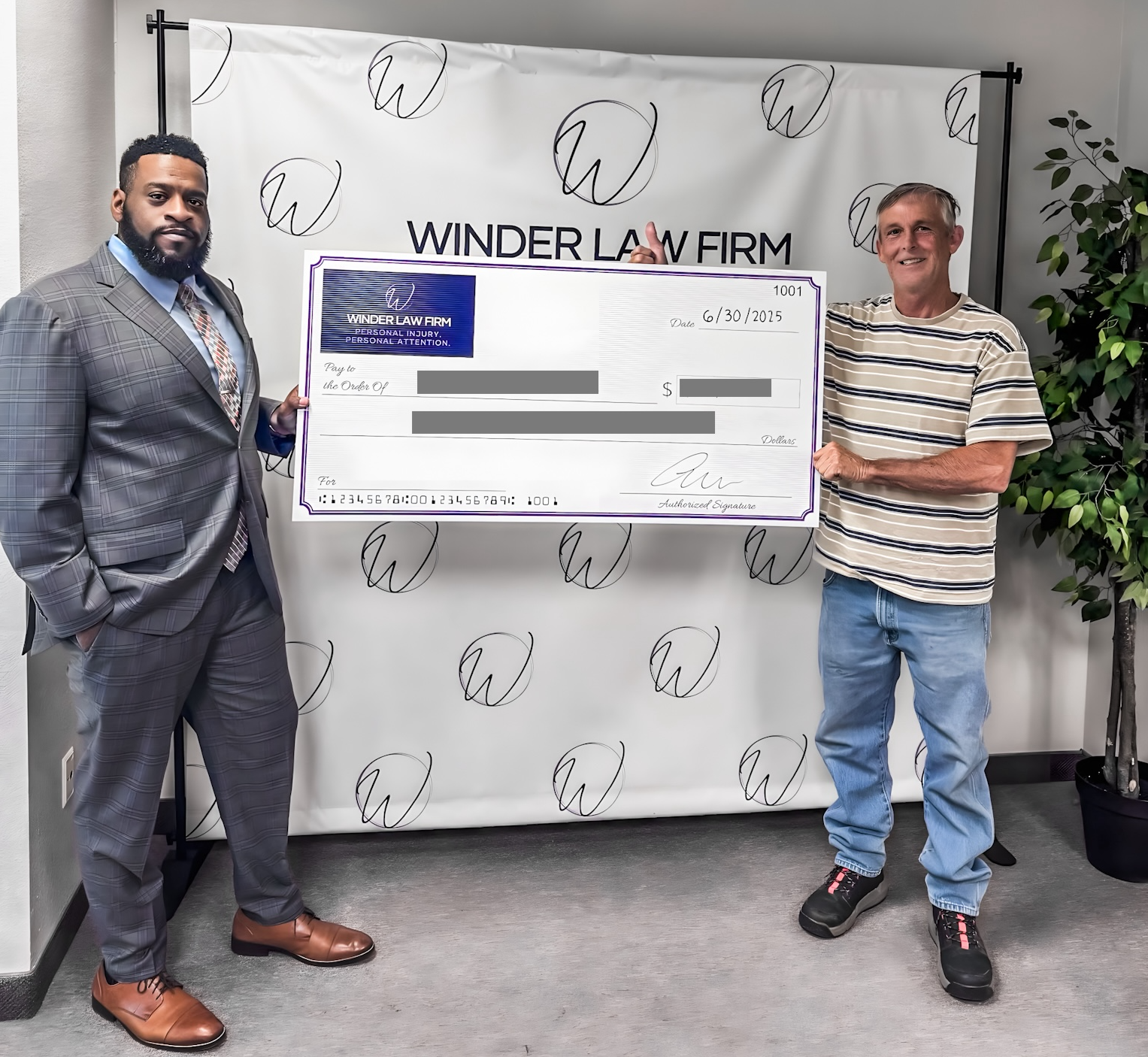
Aaron was awesome!! Met me on Saturday morning the day after an accident to get things rolling. He said we had a case, just need to be patience and things will work out. After countless PT trips, surgery, and mri's my body is back to where it was...I am not the most patience person, so I appreciate Aaron and his colleagues dealing with me and getting the maximum that was available..Local people who care about locals!!!!! I HIGHLY recommend Winder law firm.
Joe Lewis
Las Vegas, NV

My experience with the Winder Law Firm was excellent. He truly cared for my well being and was present every step of the way, until my case was resolved. I highly recommend Aaron and his team.
Sandra Deleon
Las Vegas, NV
Disclaimer: Legal outcomes vary. Past results do not guarantee future outcomes.
What Is a Spinal Cord Injury and Why Is It So Serious?
Your spinal cord is one of the most important organs in your body. This long tube of nervous tissue inside your spine is responsible for carrying signals between your brain and body. Injury impairs your spinal cord’s ability to carry these signals. If the injury is severe enough, it may result in lasting disability.
Many people with spinal cord injury need long-term medical care. Some need support for the rest of their lives.
How bad it gets depends on two things: where the damage is on the spine, and how much of the cord is affected. An injury higher up on the spine causes more widespread harm than one lower down.
How the Spinal Cord Functions
Your spinal cord connects the brain to the rest of the nervous system. When you move, feel, or breathe, that’s your brain signaling your body to do just that, and the signals your brain sends go through your spinal cord.
Damage to your spinal cord causes those signals to get cut off. The body below may no longer receive the messages it needs to function properly.
Types of Spinal Cord Injuries
Not all spinal cord injuries are the same. Some are more severe than others. This depends on how bad the damage is and where the damage is on the spine.
Finding out the exact injury matters in a claim. It helps Las Vegas spinal cord injury attorneys to determine the appropriate compensation.
Complete vs. Incomplete Injuries
With a complete spinal cord injury, everything below the damaged area stops working. The brain and body can no longer communicate. There’s no movement or feeling past that point.
An incomplete injury means there is still some function. You may still have partial movement or feeling below the damaged area.
Incomplete injuries often have a better prognosis because some of the nerves remain functional. Complete injuries are more likely to result in permanent disability.
Paralysis Conditions
Paraplegia is paralysis of the legs and lower body. It occurs when damage to the spinal cord is in the mid or lower back.
Quadriplegia, also called tetraplegia, is more severe. This happens when the injury is in the neck area of the spine. It affects all four limbs, both the arms and legs.
The higher up the injury on the spine, the more areas of the body are affected. That’s why neck injuries tend to cause the most widespread damage.
Spine Injuries vs. Spinal Cord Injuries
A spine injury and a spinal cord injury are not the same. The spine is made up of bones called vertebrae. Meanwhile, the spinal cord is the bundle of nerves that runs inside those bones.
You can hurt the spine without hurting the cord. For example, a herniated disc is damage to the structure (the “discs”) between vertebrae. It can cause pain and limited movement, but the spinal cord itself may be fine.
A spinal cord injury means the nerves themselves are damaged. That can lead to loss of movement, feeling, or organ function. The effects are sometimes permanent.
Both types are serious. But spinal cord injuries tend to carry far greater long-term consequences.
Who Can Be Sued in a Spinal Cord Injury Lawsuit?
Nevada is a fault-based state. That means the person or party who caused your injury can be held responsible for the damages. Who you can sue is a matter of how the injury happened and who caused it. More than one party may be responsible.
Possible At-Fault Parties
In Nevada, a person or party can be held liable if they failed to use reasonable care and that failure caused your injury. This is called negligence.
Here are some of the most common parties that may be held responsible:
Negligent Drivers
Vehicle accidents are one of the leading causes of spinal cord injuries. Drivers who speed, text, or drive under the influence put everyone on the road at risk. If a negligent driver caused your injury, they may be held liable for the damages.
Property Owners and Businesses
Property owners and businesses have a responsibility to keep their properties safe. If you get injured because they did nothing to fix hazards or properly maintain their premises, you might be able to file a claim against them.
Product Manufacturers
When a manufacturer makes a product, they must ensure it works as intended. A seatbelt breaks, or workplace equipment fails. If someone gets a spinal cord injury because of this, the manufacturer could be liable.
What Financial Compensation May Be Available After a Spinal Cord Injury?
A spinal cord injury requires long-term treatment and rehabilitation, sometimes for the rest of one’s life. You may be entitled to compensation for a life that has been drastically changed.
There are two types of damages for which you can get compensation. Economic damages are measurable. These are financial losses such as medical bills and lost income. Non-economic damages are the intangibles, such as pain, suffering, and impaired quality of life.
The compensation you receive depends on the severity of your injury and its impact on your life.
Medical Expenses and Long-Term Care Costs
A spinal cord injury means high medical bills. Surgery, hospital stays, and medication are all factored in. Then there are the costs for assisted living, for nurses and caregivers.
Lost Wages and Reduced Earning Capacity
A spinal cord injury prevents you from working the same way you did before. You may not be able to go back to your old job. Because your body is not the same, you face unemployment or diminished earnings.
Pain, Suffering, and Loss of Quality of Life
A spinal cord injury not only damages your body, but it also takes a toll on your mental health and quality of life. Life may be permanently changed, and some activities may no longer be possible. You lose your independence and enjoyment of life.
Future Care, Home Modifications, and Assistive Needs
Because of your injury, you might need a wheelchair or to remodel your home. You might have to modify your car. You also need to plan for rehabilitation and long-term care.
Steps to Take After a Spinal Cord Injury in Las Vegas
If you or someone near you has suffered a spinal cord injury, taking the right steps early can make a big difference. Here’s what to do:
- Get to safety. Make sure you and anyone else involved are out of immediate danger. Move to a safe spot if you can do so without worsening the injury.
- Get medical help as soon as possible. Call 911 or go to a hospital right away. With a spinal cord injury, you need medical attention fast.
- Document everything. Take photos, get contact information from witnesses, and save any accident reports.
- Follow your treatment plan. Stick to what your doctors tell you. Skipping treatment can hurt both your health and your case.
- Avoid talking to insurance companies without legal guidance. Avoid giving recorded statements or accepting early offers. Insurers may use your words to reduce your claim.
- Talk to an attorney early. The sooner you get legal help, the better your chances may be of protecting your rights and building a strong case.
Symptoms and Long-Term Effects of Spinal Cord Injuries
Spinal cord injuries have long-term, debilitating effects on your life. Some of the most common long-term effects include:
Loss of Movement and Sensation
Paralysis is a common symptom, especially for a complete spinal cord injury. Even for incomplete injuries, you can still feel numbness and loss of control and function.
Chronic Pain and Nerve Damage
Spinal cord injuries directly damage your nervous system, causing intense and chronic pain. It also causes various nerve complications, causing muscle spasms and weakness.
Emotional and Psychological Impact
A spinal cord injury will change one’s life, both physically and emotionally. With a reduced quality of life, you might face depression and anxiety. It also takes an emotional toll on family members.
How Spinal Cord Injury Claims Work in Nevada
Filing a spinal cord injury claim in Nevada is a legal process with several moving parts. At its core, you need to prove that someone else was at fault and that their actions caused real, measurable harm to you.
Proving Liability and Negligence
To prevail in a spinal cord injury case in Nevada, you need to prove the following:
- The other party had a duty to act with reasonable care, but failed to do so.
- That failure directly caused your injury.
- You suffered damages as a result.
To build that case, you need evidence. Police reports, medical records, witness statements, and expert testimony are all important when proving liability and negligence.
Comparative Fault and Shared Responsibility
Nevada follows a modified comparative negligence rule (NRS 41.141). This law states that fault can be split among many parties. You’ll receive compensation as long as you are not 50% or more at fault.
Here’s an example. Say your total damages are $100,000, and the court finds you to be 20% at fault. Your compensation drops to $80,000. But if the court finds you to be 51% at fault, you recover nothing.
Insurance companies know this. They often try to shift as much blame as possible onto the injured person to cut or avoid a payout. That makes fault allocation one of the most contested issues in these cases.
Statute of Limitations for Filing a Claim
In most cases in Nevada, you must file your spinal cord injury claims within two years of your injury under NRS 11.190(4)(e). If you miss that window, you may lose the right to recover compensation, no matter how strong your case is.
In some situations, your window for filing doesn’t start on the day of the accident. It can start from the date you discovered the injury, rather than the date of the accident itself.
There are exceptions, including the following:
- If the injured person is a minor, the deadline to file might not start until they turn 18.
- If the claim is against a government entity, there are usually shorter notice requirements and extra hoops to jump through.
- If the injury resulted from medical malpractice, different rules and damage caps may apply.
Because the deadlines vary, an early consultation with a spinal cord injury lawyer in Las Vegas is one of the best ways to protect your right to file.
Why Spinal Cord Injury Cases Are Among the Most Complex Personal Injury Claims
Spinal cord injury cases are some of the hardest personal injury claims to handle. The injuries are severe, the costs are massive, and the effects last a lifetime. That level of complexity demands expert analysis and careful long-term planning.
Lifelong Medical Costs and Life Care Planning
A spinal cord injury takes years, if not decades, of ongoing treatment and therapy. Figuring out the costs means creating a plan that estimates your expenses for the rest of your life. Getting those numbers right is critical to pursuing fair compensation.
Working With Medical Experts and Specialists
These cases rely on input from physicians, rehabilitation specialists, and life care planners. Their job is to document the full extent of the injury and explain what future care will look like. That expert testimony is often what proves the true value of the damages.
High-Stakes Insurance and Litigation Challenges
Your claim will face pushback from large insurance companies. These companies have large defense teams and use aggressive strategies. They often dispute liability and may work to minimize your claim’s value. You need strong preparation with your attorney for both negotiation and trial.
Common Causes of Spinal Cord Injuries
Spinal cord injuries can happen in a variety of ways. National data from the National Spinal Cord Injury Statistical Center, or NSCISC shows that a small number of causes likely account for most cases in the U.S.
Motor Vehicle Crashes
According to data from NSCISC, vehicle crashes are the leading cause of spinal cord injuries. They accounted for 36.88% of spinal cord injuries in recent data from 2015 to 2025.
Falls
According to that same data set from NSCISC, falls are the second most common cause of spinal cord injuries. Falls make up 33.07% of spinal cord injury cases, including falls on stairs, ladders, and from heights.
Acts of Violence
Violence accounts for 14.87% of spinal cord injuries. Many of these cases involve gun-related incidents.
Gunshot Wounds
Gunshot injuries are a major driver within violence-related cases. They account for 13.82% of all traumatic spinal cord injuries.
Sports and Recreation
Sports and recreational activities account for 7.46% of spinal cord injuries. These include activities such as football, skiing, surfing, winter sports, diving, and horseback riding.
Diving Accidents
Diving is a leading activity that leads to spinal cord injuries within sports-related injuries. It accounts for 3.30% of all spinal cord injury cases.
Medical or Surgical Complications
Some spinal cord injuries happen while the affected person is receiving medical care. These cases account for 3.67% of spinal cord injuries in national data.
Falling or Flying Objects
In some cases, spinal cord injuries occur when a person is struck by a falling or moving object. This accounts for 2.04% of cases.
Pedestrian Accidents
Pedestrians struck by vehicles make up 1.20% of spinal cord injuries.
Nevada Laws Related To Spinal Cord Injuries
If you’re considering filing a lawsuit after a spinal cord injury in Nevada, it’s helpful to understand the laws that may apply. Below are some of the most important ones.
Disclaimer: These law summaries are not exhaustive and are provided for general understanding only. They reflect Nevada law at the time of writing and may be subject to updates or change. For legal advice or a full interpretation, consult an attorney. Always check with an attorney or the Nevada Legislature for the most current information.
Nevada’s Comparative Negligence Law
NRS 41.141 – Provides that a plaintiff may recover damages if their comparative negligence is not greater than the negligence of the defendant or combined defendants, with recovery reduced in proportion to their percentage of fault and each defendant generally liable only for their share.
Example: Let’s say you suffered a spinal cord injury after slipping on a dangerous staircase and later sue, but evidence shows you were 30% at fault for ignoring a clearly marked warning sign, while the property owner was 70% at fault for failing to repair the broken stairs. If the total damages are $100,000, you may still recover compensation, but it would be reduced by 30%, resulting in a $70,000 recovery.
Nevada’s Statute of Limitations Law
NRS 11.190 – Requires that an action to recover damages for personal injury or death caused by wrongful act or neglect be commenced within 2 years.
Other Related Nevada Laws
NRS 41.130 – Establishes that a person who causes personal injury through wrongful act, neglect, or default is liable for damages, including liability that may extend to an employer responsible for that person’s conduct.
NRS 41.085 – Authorizes heirs and personal representatives to bring an action for damages when a person’s death is caused by the wrongful act or neglect of another, including claims against responsible parties and recovery of specified damages.
NRS 41A.097 – Limits the time to file a medical malpractice claim against a health care provider to specified periods based on when the injury occurred and when it was or should have been discovered, with tolling if the provider conceals the wrongdoing.
NRS 41A.071 – Requires a medical malpractice action to be filed with a supporting affidavit from a qualified medical expert or the court must dismiss the action without prejudice.
Nevada Spinal Cord Injury and Trauma Statistics
- Data from the Nevada Trauma registry can help us understand how often serious injuries happen in Nevada. In 2024, the state recorded 18,870 trauma cases, that’s a rate of 566.2 per 100,000 people.
- Clark County, the most populated county in the state, accounted for a large share of these cases. The county reported 11,746 trauma cases, with a rate of 481.3 per 100,000 residents.
- Falls were the leading cause of trauma statewide. They accounted for 11,411 cases, or 60.5% of all reported trauma injuries.
- Motor vehicle crashes were another major source of injury. These incidents accounted for 2,895 trauma cases, or 15.3% of the total.
- The data set includes incident location data, this shows where the injuries happened. A total of 9,218 trauma cases occurred at residences, representing 48.9% of all cases. That’s almost half of these serious injuries that happen at the affected person’s home or someone else’s home.
- Looking at national estimates can also help us understand the broader impact of serious injuries. Each year, estimates suggest about 500,000 people in the United States sustain brain or spinal cord injuries.
Resources for Spinal Cord Injuries in Nevada
After you or a loved one sustain a spinal cord injury, it can help to know where to look for more information. The sources below include government resources and national organizations focused on injury data, care, education, and support.
General Nevada Personal Injury Resources
Nevada Department of Health and Human Services
This agency oversees public health programs across the state. It also provides services tied to injury prevention, trauma care, and rehabilitation.
Nevada Division of Public and Behavioral Health
DPBH manages the Nevada Trauma Registry. This organization publishes Nevada statewide injury data and safety reports.
This statewide program focuses on reducing serious and fatal car crashes through public education and data reporting.
Legal Aid Center of Southern Nevada
Provides free or low-cost legal help to qualifying residents. This includes assistance with civil matters after an injury.
Nevada Judiciary Self-Help Center
Offers court forms and DIY guidance for people handling civil cases in Nevada.
Spinal Cord Injury Safety or Educational Resources
Centers for Disease Control and Prevention (CDC) – Spinal Cord Injury Section
Provides national data, prevention information, and education on spinal cord injuries, including risk factors and long-term outcomes.
National Institute of Neurological Disorders and Stroke (NINDS)
Offers medical information on spinal cord injury causes, treatment research, and recovery.
Christopher & Dana Reeve Foundation
This organization provides education, peer support, and resources for people living with spinal cord injuries.
National Spinal Cord Injury Statistical Center (NSCISC)
Publishes research on the causes of spinal cord injuries and long term outcomes, which they maintain in a national database.
Get a Free Consultation for a Spinal Cord Injury Lawsuit
If you or a loved one had an accident that resulted in a spinal cord injury, Winder Law Firm is here to help. Contact us for a free, no-obligation consultation. Take that first step to secure expert representation and compensation you may be entitled to.
Where is Winder Law Firm’s Office?
Come see us, we are located at:
7785 W Sahara Ave Suite 100, Las Vegas, NV 89117
Have you or a loved one experienced a spinal chord injury due to negligence?
 Frequently Asked Questions

Fact Checked
Winder Law Firm strives to provide accurate and timely information, but the content on this page is for informational purposes only and should not be taken as legal advice. If you need legal guidance or are considering legal action, consult an attorney. This website strives to follow applicable state bar and ABA ethical marketing rules. We are not responsible for third-party content, including linked law firms or services, and do not endorse or recommend them. We bear no liability for security risks or issues from external links.
View our editorial guidelines for more details.
Legally Approved
The content on this page has been reviewed for legal accuracy by Attorney Aaron A. Winder. This content is for informational purposes only and not legal advice. It is not a substitute for professional legal counsel. Winder Law Firm does not guarantee this website content’s accuracy, completeness, or relevance. This website may contain inaccuracies, typographical errors, or outdated information and does not necessarily reflect the firm’s or its employees’ opinions. Consult an attorney for legal guidance.

Legally Reviewed
The content on this page has been reviewed for legal accuracy by Attorney Aaron A. Winder. This content is for informational purposes only and not legal advice. It is not a substitute for professional legal counsel. Winder Law Firm does not guarantee this website content’s accuracy, completeness, or relevance. This website may contain inaccuracies, typographical errors, or outdated information and does not necessarily reflect the firm’s or its employees’ opinions. Consult an attorney for legal guidance.
Award Methodology
The CALI Excellence for the Future Award® is given to the highest-scoring student in a law school course, as determined by the instructor or registrar. This award recognizes academic excellence in legal education and is granted by the Center for Computer-Assisted Legal Instruction (CALI), a nonprofit consortium of law schools and organizations.
Attorney Aaron A. Winder, owner of Winder Law Firm, received this award in Advanced Criminal Procedure while studying at Gonzaga University School of Law.
More information about the CALI Excellence for the Future Award® can be found at CALI’s website.
Disclaimer
This page offers general information, not legal advice, and does not create an attorney‑client relationship. Allegations mentioned are unproven in court. Information is based on public sources. Inquiries may be shared with a partner firm under a marketing arrangement.