No Win, No Fee
Las Vegas T-Bone Accident Lawyer
Were you or a loved one impacted by a T-bone accident in Las Vegas or elsewhere in Nevada? You may be dealing with injuries, bills, missed work, and not know if financial recovery is even possible.
T-bone car accidents are side-impact crashes where one vehicle strikes another at a right angle. They usually happen at intersections and can be a particularly severe type of crash. This is due to sudden impact and because many cars offer only limited side protection.
If you or a loved one were injured in a T-bone accident you may have legal options to pursue compensation. You can request a free consultation here to speak with a Las Vegas T-bone accident lawyer.

No Upfront Legal Fees
Free, Confidential Case Review

Local Insight
Replies Within 1 Business Day


National Top 100 Black Lawyers

American Association for Justice
Nevada Justice Association

What We’ll Do For You
At Winder Law Firm, we try to approach every case with compassion. We understand that if you’re reading this, you’re probably going through a tough time.
That’s why, when you work with us, we focus on the legal process for you, so you can focus on recovery.
Our Las Vegas T-bone accident attorneys will want to get to work on your case promptly. The sooner we can start our investigation, the more effectively we may gather and preserve evidence.
We will need the evidence to help determine fault and who may be liable. Most T-bone crash cases involve negligence. Negligence means someone else failed to act in a reasonable manner and their actions led to harm.
When we are able to determine what parties are liable and that their negligence caused your injuries, we may help you pursue a financial recovery.
Local Experience in Clark County Courts
We are Las Vegas locals. We are very familiar with the court system in Clark County, filing requirements, litigation timelines and insurance companies.
Local experience can be very helpful for people bringing claims in Nevada. You can count on us to be prepared for:
- accident patterns and known dangerous intersections
- opposing law firms
- Nevada laws around comparative negligence and traffic liability rules
Meet Aaron A. Winder
Winder Law Firm is run by attorney Aaron A. Winder. Aaron is a 4th generation Las Vegas native and a personal injury lawyer.
Aaron’s philosophy is around client-focused compassionate representation. You can learn more about his story on his bio page.


Table of Content

- What We’ll Do For You
- Who Can Be Liable in a T-Bone Accident Lawsuit?
- What Financial Compensation May Be Available After a T-Bone Accident?
- Steps to Take If You Are Injured in a T-Bone Accident in Las Vegas
- Common Causes of T-Bone Accidents
- Common Injuries from T-Bone Accidents
- Nevada Laws Related to T-Bone Accident Claims
- Nevada Intersection Car Accident Statistics
- Why T-Bone Accidents Are More Dangerous Than Some Other Crash Types
- Resources For People Affected By T-bone Accidents in Nevada
- Where is Winder Law Firm’s Office?
Were you injured in a car accident?
TESTIMONIALS
Clients Have
Confidence In Us
← Swipe to view stories →
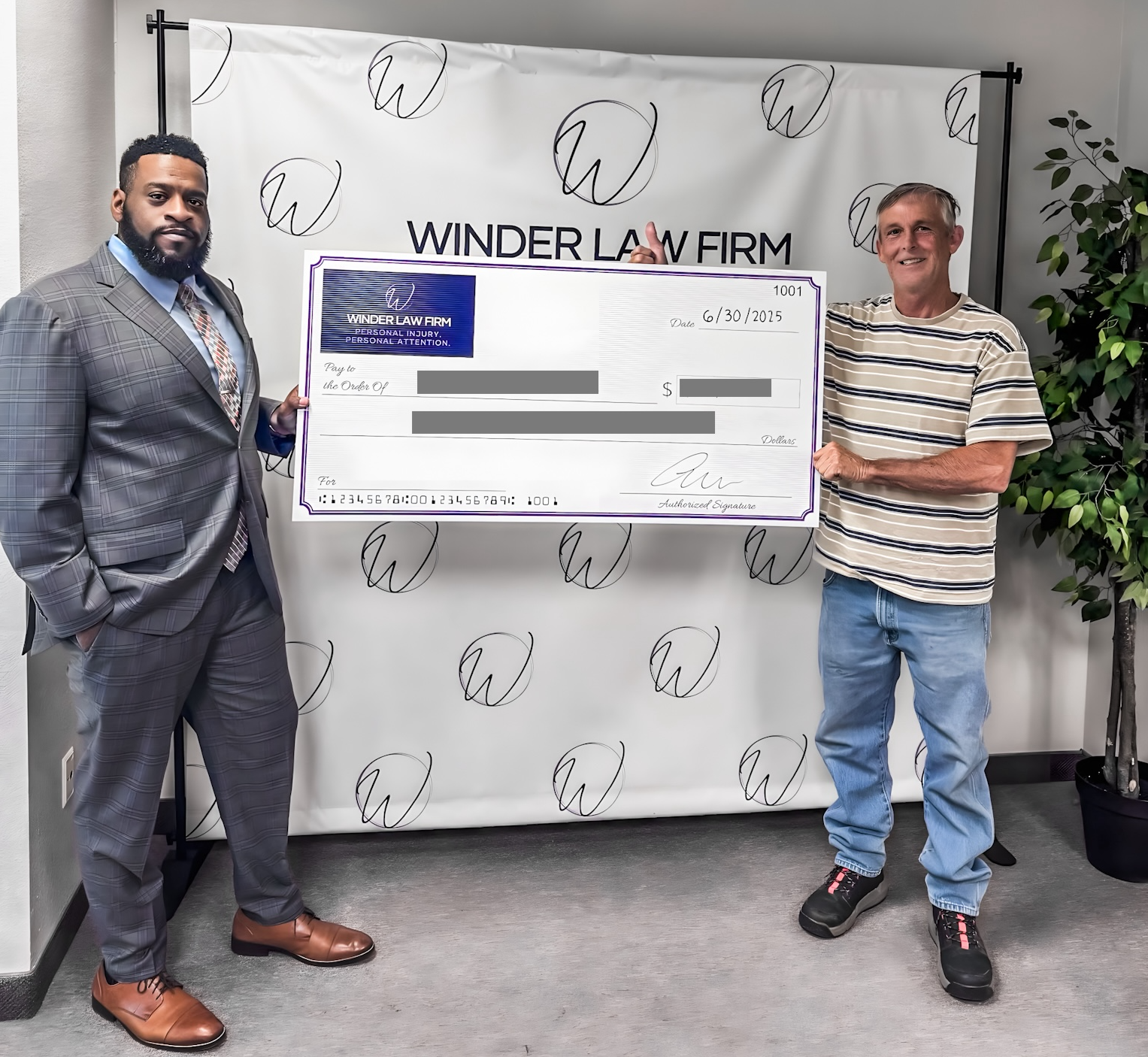
Aaron was awesome!! Met me on Saturday morning the day after an accident to get things rolling. He said we had a case, just need to be patience and things will work out. After countless PT trips, surgery, and mri's my body is back to where it was...I am not the most patience person, so I appreciate Aaron and his colleagues dealing with me and getting the maximum that was available..Local people who care about locals!!!!! I HIGHLY recommend Winder law firm.
Joe Lewis
Las Vegas, NV

My experience with the Winder Law Firm was excellent. He truly cared for my well being and was present every step of the way, until my case was resolved. I highly recommend Aaron and his team.
Sandra Deleon
Las Vegas, NV
Disclaimer: Legal outcomes vary. Past results do not guarantee future outcomes.
Who Can Be Liable in a T-Bone Accident Lawsuit?
Who can be liable in a T-bone accident largely depends on who caused or contributed to the crash. Drivers have a duty to follow the traffic laws. When there was a crash, sometimes some laws were not followed.
In Nevada, it’s possible that multiple parties share responsibility for the crash. This will depend on the individual facts of the case though.
Possible At-Fault Parties
Determining who is at fault for a T-bone accident is done through evidence. Some examples of what evidence we look to are:
- police reports
- witness statements
- traffic laws like right-of-way violations
- surveillance camera footage
- driver behavior
- external factors
This section takes a look at some parties commonly found to be at fault for T-bone crashes.
At-Fault Driver Who Failed to Yield or Ran a Red Light
Oftentimes, in a T-bone accident, the crash is the fault of a driver who violated right-of-way rules. Mainly running red lights, a stop sign, or making an unsafe left-hand turn.
Generally, a traffic violation is often a sign of negligence if there is evidence to prove that’s what happened.
Employer of the Driver
If the driver’s actions led to the crash and they were working during that time, their employer may be liable. This is due to a legal concept known as vicarious liability.
Vicarious liability means one party can be held legally responsible for the actions of another because of their relationship. For example, an employer being liable for an employee’s conduct. It often applies when the responsible party had control over the person who caused the harm.
Some examples of drivers who may have been “on the clock” doing job duties during a crash are:
- delivery drivers
- company vehicles
- commercial drivers
Rideshare Companies
If you were in a crash with a rideshare vehicle, it’s possible the liability may extend to the rideshare company like Uber or Lyft. This generally depends on the driver status at the time of the accident though. For example, when the driver is:
- logged into the app
- transporting a passenger
Insurance coverage for rideshare vehicles differs based on the status of the ride.
Vehicle Owner for Negligent Entrustment
Sometimes the owner of the vehicle can be at fault too. This can happen if they let a person use the vehicle when they should have known that person was not safe to drive.
For example, maybe the owner lent the car to someone:
- who was drunk
- had no license
- was known to drive recklessly
The key issue is what the owner knew, or what they should have known.
Vehicle or Parts Manufacturers
Sometimes the vehicle or parts manufacturer is liable in a crash. Product liability laws may apply if defective parts led to the crash. For example:
- brakes
- airbags
- steering function
One scenario would be brake failure at an intersection. Keep in mind that expert analysis would be needed to establish the defect.
Government Entities
Government entities responsible for maintaining the roads can also be a liable party to a crash. Some examples of this include:
- poor road design or intersection layout
- missing signs
- malfunctioning traffic lights
It’s important to note that claims against the government can involve special deadlines and procedures.
Who Can Be Liable in a T-Bone Accident Lawsuit?
Who can be liable in a T-bone accident largely depends on who caused or contributed to the crash. Drivers have a duty to follow the traffic laws. When there was a crash, sometimes some laws were not followed.
In Nevada, it’s possible that multiple parties share responsibility for the crash. This will depend on the individual facts of the case though.
Possible At-Fault Parties
Determining who is at fault for a T-bone accident is done through evidence. Some examples of what evidence we look to are:
- police reports
- witness statements
- traffic laws like right-of-way violations
- surveillance camera footage
- driver behavior
- external factors
This section takes a look at some parties commonly found to be at fault for T-bone crashes.
At-Fault Driver Who Failed to Yield or Ran a Red Light
Oftentimes, in a T-bone accident, the crash is the fault of a driver who violated right-of-way rules. Mainly running red lights, a stop sign, or making an unsafe left-hand turn.
Generally, a traffic violation is often a sign of negligence if there is evidence to prove that’s what happened.
Employer of the Driver
If the driver’s actions led to the crash and they were working during that time, their employer may be liable. This is due to a legal concept known as vicarious liability.
Vicarious liability means one party can be held legally responsible for the actions of another because of their relationship. For example, an employer being liable for an employee’s conduct. It often applies when the responsible party had control over the person who caused the harm.
Some examples of drivers who may have been “on the clock” doing job duties during a crash are:
- delivery drivers
- company vehicles
- commercial drivers
Rideshare Companies
If you were in a crash with a rideshare vehicle, it’s possible the liability may extend to the rideshare company like Uber or Lyft. This generally depends on the driver status at the time of the accident though. For example, when the driver is:
- logged into the app
- transporting a passenger
Insurance coverage for rideshare vehicles differs based on the status of the ride.
Vehicle Owner for Negligent Entrustment
Sometimes the owner of the vehicle can be at fault too. This can happen if they let a person use the vehicle when they should have known that person was not safe to drive.
For example, maybe the owner lent the car to someone:
- who was drunk
- had no license
- was known to drive recklessly
The key issue is what the owner knew, or what they should have known.
Vehicle or Parts Manufacturers
Sometimes the vehicle or parts manufacturer is liable in a crash. Product liability laws may apply if defective parts led to the crash. For example:
- brakes
- airbags
- steering function
One scenario would be brake failure at an intersection. Keep in mind that expert analysis would be needed to establish the defect.
Government Entities
Government entities responsible for maintaining the roads can also be a liable party to a crash. Some examples of this include:
- poor road design or intersection layout
- missing signs
- malfunctioning traffic lights
It’s important to note that claims against the government can involve special deadlines and procedures.
What Financial Compensation May Be Available After a T-Bone Accident?
Compensation in a T-bone accident lawsuit covers both financial losses and personal impact of injuries. The damages can vary based on the severity of injuries and the long-term consequences.
In a claim or lawsuit there are generally two main types of damages sought.
- Economic damages
- Non-economic damages
Economic damages are simple to calculate. They are tied to exact dollar amounts that were lost due to the accident. Think things like medical expenses, property damage, and lost wages.
Non-economic damages are for losses that don’t directly have dollar amounts tied to them. For example: pain and suffering, emotional distress, loss of enjoyment etc.
If the car accident was fatal one can also sue for wrongful death damages. In rare and extreme cases with extreme behavior or recklessness, there may also be punitive damages to punish the liable party.
Steps to Take If You Are Injured in a T-Bone Accident in Las Vegas
If you are injured in a Las Vegas T-bone accident, it’s essential to prioritize safety, then legal protection. Early action and good documentation can help protect your health and legal claim.
Here are some steps you can consider following:
- Make sure you and others are safe. Move out of traffic if possible to prevent further harm.
- Call 911 to ensure law enforcement documents the crash and makes an official report.
- Seek medical attention immediately, even if there are no symptoms or they seem minor. Some injuries like whiplash can take time to show symptoms.
- Take photos and videos of the scene. This includes vehicle damage, intersection layout, traffic signals, and visible injuries.
- Collect the names, contact information, and statements from witnesses and other involved drivers.
- Avoid giving recorded statements or accepting blame when speaking to insurance companies. We recommend talking to a lawyer before you talk to insurance providers.
- If you want to, contact a Las Vegas T-bone accident attorney early to help preserve evidence and protect your claim.
Common Causes of T-Bone Accidents
These are some of the more common causes of T-bone accidents. Please note that some of these causes were derived from general car accident data.
Red-Light Running
Running a red light is one of the most common causes of T-bone crashes. IIHS links front-into-side collisions closely with red-light violations.
Failure to Stop or Yield
Data from FHWA indicates that angle crashes are the most common type at stop-controlled intersections.
Unsafe Left Turns
The FHWA says that left-turns across oncoming traffic are a major crash type at intersections.
Speeding
Speeding gives drivers less time to react at intersections. The NHTSA states speeding increases both crash risk and injury severity.
Distracted Driving
A distracted driver may miss a red light, stop sign, or crossing vehicle. The NHTSA warns that any non-driving activity can increase crash risk.
Alcohol Impairment
Driving under the influence of too much alcohol is dangerous. The NHTSA says crash risk rises sharply at a BAC of .08 or higher.
Poor Intersection Design
Some intersections are harder to navigate due to skewed angles or poor layout. The FHWA found fewer driver errors at right-angle intersections than skewed intersections.
Common Injuries from T-Bone Accidents
A T-bone accident is not a minor crash in many cases. Side impacts can be severe because there is less space between the person and the striking vehicle.
For some people, recovering from accident injuries can take months. For others, the negative effects remain for a much longer time period.
Here are some of the more common injuries from T-bone crashes:
- Head trauma is one of the more common injuries. This can range from minor bumps to serious brain damage. A concussion or traumatic brain injury can happen from the violent motion or from hitting part of the vehicle.
- Neck injuries are also common. Whiplash can happen when the head and neck are thrown side to side.
- A serious side impact can damage the spinal cord. That can lead to partial or full paralysis.
- Some injuries happen inside the body. Internal organ damage and internal bleeding are possible after a forceful hit.
- Broken bones are common in T-bone crashes, especially ribs, the pelvis, and shoulders.
- Facial injuries can happen after contact with windows, doors, or other structural parts of the vehicle.
Nevada Laws Related to T-Bone Accident Claims
This section reviews some of the laws relevant to T-bone accident claims in Nevada.
Disclaimer: These law summaries are not exhaustive and are provided for general understanding only. They reflect Nevada law at the time of writing and may be subject to updates or change. For legal advice or a full interpretation, consult an attorney. Always check with an attorney or the Nevada Legislature for the most current information.
Nevada’s Comparative Negligence Law
NRS 41.141 – Allows an injured person to recover damages if they are not more at fault than the defendant or combined defendants, with the award reduced by their percentage of fault.
Example: An injured driver is found to be 40% at fault for a T-bone accident, while the other driver is 60% at fault for running a red light. If the total damages are $100,000, the injured driver can still recover compensation, but it would be reduced by 40%, resulting in a $60,000 recovery.
Nevada’s Statute of Limitations
NRS 11.190 – Requires personal injury and wrongful death claims to be filed within 2 years of the injury or death caused by another’s wrongful act.
Nevada Specific Laws related to T-Bone Accidents
NRS 41.130 – Holds a person (and potentially their employer) liable for damages when they cause injury through wrongful acts, neglect, or default.
NRS 41.085 – Allows heirs and personal representatives to bring a lawsuit and recover damages when a person’s death is caused by another’s wrongful act or negligence.
NRS 484B.250 – Requires drivers to yield the right-of-way at intersections based on position and timing.
NRS 484B.253 – Requires drivers turning left at an intersection to yield to oncoming traffic that poses an immediate hazard.
NRS 484B.257 – Requires drivers to stop at stop signs or yield at yield signs and give the right-of-way to vehicles already in or approaching the intersection.
NRS 484B.270 – Requires drivers to exercise due care, yield when required, and maintain safe distance when interacting with bicycles, electric bicycles, electric scooters, and pedestrians.
NRS 484E.010 – Requires a driver involved in a crash causing injury or death to immediately stop, remain at the scene, and fulfill required duties.
NRS 484E.030 – Requires drivers involved in a crash to provide identifying information, show their license upon request, render reasonable aid to injured persons, and report the crash if no police officer is present.
Nevada Intersection Car Accident Statistics
According to Nevada’s 2021-2025 Strategic Highway Safety Plan, 35% of the state’s fatal and serious injury crashes occurred in an intersection.
Nevada Intersection and Pedestrian Task Force materials from 2014-2018 also report that 31% of total traffic fatalities were intersection-related during the reviewed period.
It also notes that 42% of fatal intersection crashes were angle crashes and that 55% of fatal intersection crashes happened from dusk to dawn.
Why T-Bone Accidents Are More Dangerous Than Some Other Crash Types
T-bone accidents can be more dangerous than some other kind of car accidents like rear-end or front-end crashes. This is mostly because of where the impact happens. The side of a vehicle has less space and less structure to absorb force.
In a front crash, the hood and engine area can help take some of the impact. In a rear crash, the trunk area can absorb some force. In a side crash, the hit is much closer to the people inside.
Limited Side Protection Compared to Front and Rear Crumple Zones
Front and rear crumple zones are common in newer vehicles. They help take in crash energy. The sides of most cars do not have the same amount of space or structure. Passengers are closer to the point of impact, with less material between them and the striking vehicle. Side airbags can help, but serious injury is still possible.
Higher Likelihood of Intersection Speeds and Direct Impact
Since many T-bone crashes happen at intersections these crashes are often unexpected. Drivers and passengers may have little or no time to react or brace for impact.
Increased Risk of Multi-Vehicle Collisions and Secondary Impacts
It’s important to note that side impact can also push a vehicle into another lane. That can lead to more crashes with other cars. These dynamics can cause a vehicle to spin, roll over, or strike another fixed object.
Each additional impact can increase the severity of injuries. It can also make fault issues more complex.
Resources For People Affected By T-bone Accidents in Nevada
Nevada Personal Injury Resources
Nevada Department of Transportation
Provides statewide data on traffic safety and road updates.
Nevada Department of Public Safety
Oversees the Nevada highway patrol, traffic enforcement, and crash reporting systems.
Legal Aid Center of Southern Nevada
Offers free or low-cost legal help to eligible Clark County residents in civil matters, including injury-related issues.
Nevada Legislature
Provides access to Nevada laws involving negligence, liability, and accident-related claims.
Nevada Judiciary
Offers court forms, case information, and guidance for people handling Nevada legal matters.
T-Bone Accident Related Safety or Educational Resources
Zero Fatalities Nevada
Provides Nevada crash data, intersection safety education, and materials on risky driving behavior.
Federal Highway Administration
Publishes research and safety guidance on intersections, traffic flow, and side-impact crash prevention.
National Highway Traffic Safety Administration
Offers national crash data and safety information related to intersections, signals, and right-of-way violations.
Where is Winder Law Firm’s Office?
Come see us, we are located at:
7785 W Sahara Ave Suite 100, Las Vegas, NV 89117
Were you injured in a car accident?
 Frequently Asked Questions

Fact Checked
Winder Law Firm strives to provide accurate and timely information, but the content on this page is for informational purposes only and should not be taken as legal advice. If you need legal guidance or are considering legal action, consult an attorney. This website strives to follow applicable state bar and ABA ethical marketing rules. We are not responsible for third-party content, including linked law firms or services, and do not endorse or recommend them. We bear no liability for security risks or issues from external links.
View our editorial guidelines for more details.
Legally Approved
The content on this page has been reviewed for legal accuracy by Attorney Aaron A. Winder. This content is for informational purposes only and not legal advice. It is not a substitute for professional legal counsel. Winder Law Firm does not guarantee this website content’s accuracy, completeness, or relevance. This website may contain inaccuracies, typographical errors, or outdated information and does not necessarily reflect the firm’s or its employees’ opinions. Consult an attorney for legal guidance.

Legally Reviewed
The content on this page has been reviewed for legal accuracy by Attorney Aaron A. Winder. This content is for informational purposes only and not legal advice. It is not a substitute for professional legal counsel. Winder Law Firm does not guarantee this website content’s accuracy, completeness, or relevance. This website may contain inaccuracies, typographical errors, or outdated information and does not necessarily reflect the firm’s or its employees’ opinions. Consult an attorney for legal guidance.
Award Methodology
The CALI Excellence for the Future Award® is given to the highest-scoring student in a law school course, as determined by the instructor or registrar. This award recognizes academic excellence in legal education and is granted by the Center for Computer-Assisted Legal Instruction (CALI), a nonprofit consortium of law schools and organizations.
Attorney Aaron A. Winder, owner of Winder Law Firm, received this award in Advanced Criminal Procedure while studying at Gonzaga University School of Law.
More information about the CALI Excellence for the Future Award® can be found at CALI’s website.
Disclaimer
This page offers general information, not legal advice, and does not create an attorney‑client relationship. Allegations mentioned are unproven in court. Information is based on public sources. Inquiries may be shared with a partner firm under a marketing arrangement.