No Win, No Fee
Las Vegas Rear-End Accident Lawyer
Rear-ended while driving? You deserve clear information, not confusion. Many drivers and passengers are left dealing with the same concerns after a crash.
Worried about medical bills, lost income, and vehicle damage after a rear-end accident? A Las Vegas Rear-End Accident Lawyer can help you explore your options.
Let’s discuss your case in a free case review today.

No Upfront Legal Fees
Free, Confidential Case Review

Local Insight
Replies Within 1 Business Day


National Top 100 Black Lawyers

American Association for Justice

Nevada Justice Association

What We’ll Do For You
After a rear-end accident, many people are left facing financial and emotional stress. They’re dealing with vehicle damage, medical bills, missed work, bills piling up, and the general hassle of insurance claims. Working with a Las Vegas rear-end accident lawyer is a helpful way to find out what options you have.
We put our firm between you and your claim, so that you can focus on what matters: your recovery. We’ll handle crash investigation, gathering evidence, having a professional review of the medical records, and more.
On top of all that, we identify possible sources of compensation in line with the facts of your case. The insurance companies aren’t on your side, and they do not always make it easy. We’re ready to handle your communication, negotiation, and advocacy, so you can pursue compensation you may be entitled to.
Local Experience in Clark County Courts
Las Vegas rear-end accident claims are governed by Nevada state law, but the actual court filings happen in Clark County courts. The first step to moving your case forward is knowing the local court procedures and regional insurance defense strategies. This is where working with experienced Las Vegas rear-end accident lawyers can be valuable.
Meet Aaron A. Winder
Aaron A. Winder is the founder of the community-focused Winder Law Firm. Our firm represents individuals harmed by accidents all throughout Las Vegas. With a focus on personal injury, our strong community ties mean we advocate for our neighbors’ interests.
Aaron is a Las Vegas native and has been working closely with local clients for years. Cases Winder Law Firm handles receive personalized attention and clear communication.


Table of Content

- What We’ll Do For You
- Who Can Be Sued in a Rear-End Accident Lawsuit?
- What Financial Compensation May Be Available After a Rear-End Accident?
- Steps to Take If You Are Rear-Ended in Las Vegas
- Common Injuries from Rear-End Accidents
- How Fault Is Determined in Rear-End Accidents
- Why Rear-End Accidents Are More Complex Than They Seem
- Common Causes of Rear-End Car Crashes
- Nevada Laws Related To Rear-End Car Accidents
- Nevada Rear-End Accident Related Statistics
- Resources for Rear-End Car Accidents in Nevada
- Where is Winder Law Firm’s Office?

Have you or a loved one been injured in a rear-end accident?
TESTIMONIALS
Clients Have
Confidence In Us
← Swipe to view stories →
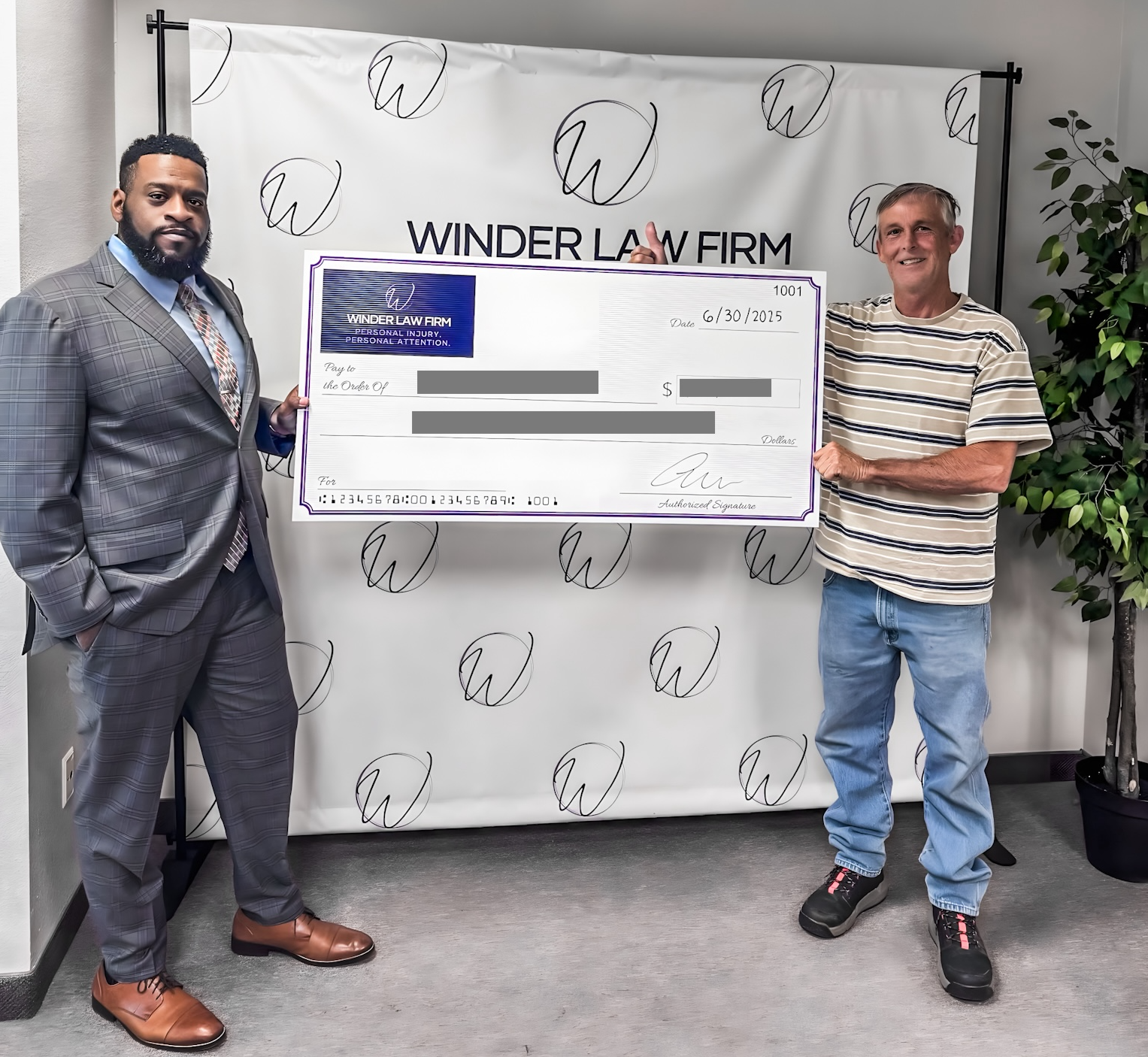
Aaron was awesome!! Met me on Saturday morning the day after an accident to get things rolling. He said we had a case, just need to be patience and things will work out. After countless PT trips, surgery, and mri's my body is back to where it was...I am not the most patience person, so I appreciate Aaron and his colleagues dealing with me and getting the maximum that was available..Local people who care about locals!!!!! I HIGHLY recommend Winder law firm.
Joe Lewis
Las Vegas, NV

My experience with the Winder Law Firm was excellent. He truly cared for my well being and was present every step of the way, until my case was resolved. I highly recommend Aaron and his team.
Sandra Deleon
Las Vegas, NV
Disclaimer: Legal outcomes vary. Past results do not guarantee future outcomes.
Who Can Be Sued in a Rear-End Accident Lawsuit?
Since Nevada follows a fault-based liability model, a person found responsible for an accident may also be liable for resulting damages. One of the major challenges, though, is determining that fault. That determination has a big impact on how a claim moves forward.
Possible At-Fault Parties
When it comes to rear-end accidents, a lot of the issues lie with what actually caused the crash. It might be driver behavior, or it could be vehicle issues. It might be road conditions, or it could be driver distraction.
A meticulous review of the evidence can help identify responsible parties. Also, since there is the potential for more than one contributing factor, multiple parties may end up being determined liable in a claim. This impacts both fault determination and applicable insurance coverage.
Rear Driver Liability
In lots of rear-end accidents, the rear driver is assumed to be at fault. This is because the rules of the road hold the driver responsible for maintaining a safe following distance. They also have the responsibility of stopping in time.
The most common causes of rear driver negligence include distracted driving, speeding, tailgating, and driving while impaired. That said, these presumptions don’t apply in every case.
Lead Driver Liability
Another possibility for liability determination is that fault could lie with the lead driver. This is often seen in cases where the lead driver stops suddenly, but unnecessarily. Brake checking is illegal and can contribute to a collision.
It may also apply when the lead driver reverses suddenly or has faulty brake lights. Cases like these may see the fault split between drivers.
Third Parties
Rare cases of rear-end accidents place the fault on third parties, or parties other than the rear and lead drivers. Third-party liability might look like a brake pad manufacturer’s defect that causes loss of stopping power. Employers or even the government may find themselves involved as third-party defendants.
What Financial Compensation May Be Available After a Rear-End Accident?
Like any accident, a rear-end accident means the costs aren’t just immediate. Victims see short-term and long-term financial distress. Compensation is designed to cover losses that are related to the crash. The potential value of a claim depends on factors like how bad the injuries are and how much the victim’s life will be impacted.
Economic Damages
Economic damages are the usual damages and losses most people think of after a rear-end accident. These typically have bills, receipts, or invoices tied to them:
- Medical bills. This covers emergency care, hospital follow-ups, doctor visits, imaging needs, and all rehab needed.
- Ongoing care: Here’s where the physical therapy and medications are included.
- Lost wages: When you’re injured, you miss work. When you can work, you typically can’t work the same. These costs all add up.
- Property damage: Your vehicle needs to be replaced or repaired. Also included here is anything else damaged in the accident, like your glasses, phone, and so on.
- Out-of-pocket costs: Even if your car is totaled, you still need to get around. Transportation costs like rentals, rideshare charges, and more may all be included here.
Non-Economic Damages
Non-economic damages are things that are harder to quantify and measure. Non-economic damages try to approximate compensation for the pain of injuries and the emotional distress of the accident. It may even account for injuries that impact domestic relationships and overall quality of life.
Punitive Damages in Severe Cases
Sometimes, extremely negligent behavior causes particularly grievous injuries. Cases like these may involve punitive damages intended to punish wrongful conduct. It’s important to note that these are very rare.
Steps to Take If You Are Rear-Ended in Las Vegas
Being involved in a rear-end accident in Las Vegas can be traumatic. Taking the right steps as quickly as possible can not only strengthen your case but also protect your rights.
- Check for injuries: The first thing you should do is make sure there are no life-threatening injuries that require care.
- Move to safety: Get out of traffic, or move to as safe a location as possible.
- Call 911: Notify emergency services so that police and medical transport can be dispatched.
- Get medical care: Even if you feel fine or aren’t visibly injured, get a medical evaluation as soon as possible.
- Document everything: Take all of the pictures and video you can of the scene. Document everything from the weather and road conditions to the position and condition of the vehicles and drivers. Get everything you can.
- Gather information: Speak to the other parties involved and exchange contact details and insurance information.
- Talk to witnesses: If anyone saw the accident happen, get their contact information if possible.
- Tell your insurance company: Notify your insurance company of the accident by providing them with basic details. Do not chat on the recorded line, the insurer is not on your side and may try to minimize your payout.
- Talk to a lawyer: Finally, consult with Las Vegas rear-end accident lawyers. They can handle communications and negotiate on your behalf.
Common Injuries from Rear-End Accidents
Rear-end accidents are known for causing a wide variety of injuries to the entire body. The sudden directional force can be devastating to the body. Injuries common to rear-end accidents include:
- Whiplash
- Concussions and TBIs
- Herniated or compressed discs
- Injuries to soft tissues
- Spinal injuries
- Internal bleeding
- Organ rupture
Don’t forget that after a rear-end accident, injuries and pain aren’t always immediate. Sometimes they take hours, even days, to set in. Pain and stiffness are common in the weeks following a rear-end crash.
How Fault Is Determined in Rear-End Accidents
Fault is determined by negligence. Negligence is failing to act with reasonable care. To determine fault, insurance companies and Las Vegas rear-end accident attorneys review substantial evidence, including police reports, witness statements, photos, and sometimes, accident reconstructions.
Even though there’s often the assumption that the rear driver is at fault, this isn’t always true. Each case has to be investigated on its own facts to determine the extent of fault and liability.
Nevada’s Comparative Negligence Rule
When dealing with personal injury claims in Nevada, the modified comparative negligence rule can be a double-edged sword. State law allows more than one person to be assigned fault in a rear-end accident.
As a result, responsibility can be shared, but compensation can be reduced. If you have total damages of $100,000, but have 25% fault, your maximum payout will be $75,000.
When the Rear Driver Is Not 100% at Fault
We’ve mentioned a few times that it’s not a hard-and-fast rule that the rear driver is always at fault. So, what happens when the blame is shared?
These are typically cases where the lead driver makes an abrupt stop. This is always sudden, but it may be with or without cause. Some cases involve multi-vehicle collisions where there are several drivers contributing to a chain-reaction scenario.
Cases like these may see fault distributed among three or more parties.
Why Rear-End Accidents Are More Complex Than They Seem
Most people have this impression that rear-end accidents are simple, and that checking a few boxes means it’s payout time. The truth is that they involve more legal and medical complexity than is expected. A lot goes into proving what happened, injury documentation, and simply dealing with insurance companies.
Hidden Injuries
Some injuries from accidents, like getting rear-ended, aren’t visible right away. Sometimes, with conditions like whiplash, it can take a day or more for pain and stiffness to really set in.
These delays can make injuries look less severe if they aren’t documented right away. This particularly applies if the symptoms aren’t visible or obvious.
Multi-Vehicle Chain Reactions
On highways or busier roads, rear-end accidents can impact more than two drivers. They can become chain-reaction accidents that leave multiple people hurt. Determining fault in cases like these gets more complicated with the number of drivers involved.
Insurance Disputes and Low Initial Offers
On top of everything else, insurance companies generally owe duties to their business interests, not to you. This means their main goal, in every situation, is to pay you as little as possible. It may be helpful to speak with an experienced local attorney.
Common Causes of Rear-End Car Crashes
Most rear-end crashes happen when a driver cannot stop in time. Studies show that these collisions are often linked to a small number of repeat causes.
Looking Away from the Road
Distraction plays a major role in rear-end crashes. A 2024 study identifies “off-road glances” as a key cause.
Driving Too Close
Following another vehicle too closely, or “tailgating,” limits reaction time. The same study mentioned above lists “too-short headway” as one of the main crash causes.
Failure to Brake Hard Enough
In some cases, drivers do not apply enough braking pressure to avoid a crash. The 2024 research also identifies failure to use maximum deceleration as a specific rear-end crash mechanism.
Fatigue
A tired driver may fail to react in time while driving a vehicle. Research includes sleepiness or fatigue as one of the main causes of rear-end car crashes.
Sudden Changes in Traffic Flow
Rear-end crashes often happen in stop-and-go traffic conditions. The Federal Highway Administration (FHWA) explains on their website that congestion can create sudden changes that increase crash risk.
Turning Traffic at Intersections
When a vehicle slows or stops to turn, a following driver may not react in time. The FHWA says this as a common rear-end crash situation.
Nevada Laws Related To Rear-End Car Accidents
If you’re considering filing a lawsuit after a rear-end car accident in Nevada, it’s helpful to understand the laws that may apply. Below are some of the most important ones.
Disclaimer: These law summaries are not exhaustive and are provided for general understanding only. They reflect Nevada law at the time of writing and may be subject to updates or changes. For legal advice or a full interpretation, consult an attorney. Always check with an attorney or the Nevada Legislature for the most current information.
Nevada’s Comparative Negligence Law
NRS 41.141 – Allows a plaintiff to recover damages if their negligence is not greater than the defendants’ combined negligence, with recovery reduced by their percentage of fault.
Example: Let’s say you were rear-ended in traffic and later sue, but evidence shows you were 30% at fault because your brake lights were not working, while the driver who struck you from behind was 70% at fault for following too closely and failing to stop. If the total damages are $100,000, you may still recover compensation, but it would be reduced by 30%, resulting in a $70,000 recovery.
Nevada’s Statute of Limitations Law
NRS 11.190 – Requires certain types of legal actions, including personal injury and wrongful death claims, to be filed within specified time periods, including a 2-year limitation for injury or death claims.
Other Related Nevada Laws
NRS 484B.127 – Requires drivers to maintain a reasonable and prudent following distance based on speed, traffic, and road conditions.
NRS 484B.600 – Requires drivers to operate a vehicle at a speed that is reasonable and proper under the conditions and not exceed posted speed limits.
NRS 484B.283 – Requires drivers to yield to pedestrians in crosswalks, avoid passing stopped vehicles at crosswalks, and obey pedestrian traffic-control signals.
NRS 484E.010 – Requires a driver involved in a crash resulting in injury or death to immediately stop, return to, and remain at the scene until required duties are completed.
NRS 484E.030 – Requires a driver involved in a crash to provide identifying information, show a license upon request, render reasonable assistance to injured persons, and report the crash if no police officer is present.
NRS 484E.070 – Requires a driver involved in a crash resulting in injury, death, or property damage of $750 or more to submit a written or electronic report to the Department within 10 days, unless the crash is fully investigated and reported by law enforcement.
NRS 41.085 – Allows heirs and personal representatives of a decedent to bring an action for damages when a person’s death is caused by the wrongful act or neglect of another.
Nevada Rear-End Accident Related Statistics
Nevada crash reports show that rear-end collisions occur in several fatal crash settings. From 2014 to 2018, there were 29 fatal rear-end intersection crashes, representing 6% of fatal intersection crashes.
In that same time period, there were 495 fatalities and 457 fatal intersection crashes overall in the state of Nevada.
Most of these crashes happened on urban roads. More than 90% of fatal intersection crashes occurred in urban areas.
Clark County had the highest number of fatal intersection crashes in the state.
Rear-end crashes also appear in impaired driving, speeding, and distracted driving data. Nevada recorded 57 fatal rear-end impaired driving crashes (8%), 59 fatal rear-end speeding crashes (13%), and 6 fatal rear-end distracted driving crashes (10%).
Resources for Rear-End Car Accidents in Nevada
Legal and Government Resources
Nevada Department of Motor Vehicles (DMV)
The DMV provides driver education materials focused on safe following distance, braking awareness, and defensive driving.
National Highway Traffic Safety Administration (NHTSA)
NHTSA offers national crash data and safety guidance on risks such as distracted driving and following too closely.
Offers access to Nevada laws related to traffic violations and liability.
Legal Aid Center of Southern Nevada
Provides legal support to qualifying individuals after an injury.
Las Vegas Metropolitan Police Department (LVMPD)
Handles crash investigations and reporting in Las Vegas and Clark County.
Accident-Specific Safety or Educational Resources
Promotes awareness of risky driving behaviors tied to crashes.
Federal Highway Administration (FHWA)
Offers research on traffic safety and roadway conditions.
Insurance Institute for Highway Safety (IIHS)
Provides testing and data on crash prevention systems for rear-end collisions.
Where is Winder Law Firm’s Office?
Come see us, we are located at:
7785 W Sahara Ave Suite 100, Las Vegas, NV 89117
Have you or a loved one been injured in a rear-end accident?
 Frequently Asked Questions

Fact Checked
Winder Law Firm strives to provide accurate and timely information, but the content on this page is for informational purposes only and should not be taken as legal advice. If you need legal guidance or are considering legal action, consult an attorney. This website strives to follow applicable state bar and ABA ethical marketing rules. We are not responsible for third-party content, including linked law firms or services, and do not endorse or recommend them. We bear no liability for security risks or issues from external links.
View our editorial guidelines for more details.
Legally Approved
The content on this page has been reviewed for legal accuracy by Attorney Aaron A. Winder. This content is for informational purposes only and not legal advice. It is not a substitute for professional legal counsel. Winder Law Firm does not guarantee this website content’s accuracy, completeness, or relevance. This website may contain inaccuracies, typographical errors, or outdated information and does not necessarily reflect the firm’s or its employees’ opinions. Consult an attorney for legal guidance.

Legally Reviewed
The content on this page has been reviewed for legal accuracy by Attorney Aaron A. Winder. This content is for informational purposes only and not legal advice. It is not a substitute for professional legal counsel. Winder Law Firm does not guarantee this website content’s accuracy, completeness, or relevance. This website may contain inaccuracies, typographical errors, or outdated information and does not necessarily reflect the firm’s or its employees’ opinions. Consult an attorney for legal guidance.
Award Methodology
The CALI Excellence for the Future Award® is given to the highest-scoring student in a law school course, as determined by the instructor or registrar. This award recognizes academic excellence in legal education and is granted by the Center for Computer-Assisted Legal Instruction (CALI), a nonprofit consortium of law schools and organizations.
Attorney Aaron A. Winder, owner of Winder Law Firm, received this award in Advanced Criminal Procedure while studying at Gonzaga University School of Law.
More information about the CALI Excellence for the Future Award® can be found at CALI’s website.
Disclaimer
This page offers general information, not legal advice, and does not create an attorney‑client relationship. Allegations mentioned are unproven in court. Information is based on public sources. Inquiries may be shared with a partner firm under a marketing arrangement.